Planning a wedding in India is an exhilarating journey, a vibrant and profound tapestry woven with threads of tradition, emotion, family, and celebration. From the moment you say “yes,” you embark on an adventure that is as complex as it is beautiful. The sheer scale of the “Big Fat Indian Wedding” is legendary, a spectacle of color, sound, and spirit that captivates the world. But behind every seamless celebration lies a monumental planning effort.
Where do you even begin? How do you orchestrate a dozen vendors, manage the expectations of hundreds of guests, and navigate age-old rituals, all while staying within budget and, most importantly, sane?
The answer lies in a plan. Not just any plan, but a definitive, exhaustive resource. What you need is the ultimate wedding planning checklist India experts and seasoned couples swear by. This guide is more than a simple list; it is your month-by-month companion, your strategic manual designed to transform the mammoth task of orchestrating an Indian wedding into a manageable, logical, and even joyful process. Our goal is to empower you with the knowledge to make informed decisions at every stage.
This guide will walk you through everything, from setting a vision 12 months out to your final sigh of relief a week before the big day. Whether your dream is a grand palace wedding under the Rajasthani stars, an intimate beach ceremony in Goa, or a chic, modern celebration in your home city, this timeline will ensure you are always one step ahead.
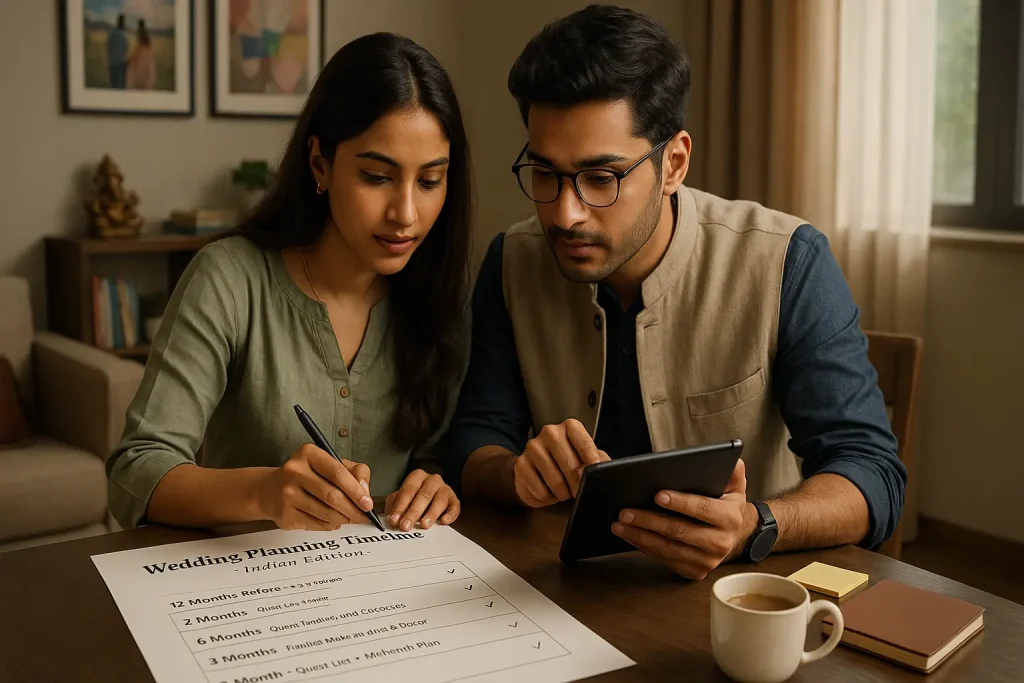
Why a Detailed Wedding Timeline is Non-Negotiable in India
Planning a wedding is always exciting, but let’s be honest—Indian weddings operate on a whole different level of glorious complexity. They are a grand symphony of sacred rituals, intricate family coordination, multi-layered vendor negotiations, and a universe of cultural and social expectations. In this incredibly dynamic environment, a structured wedding timeline India isn’t just a helpful tool; it’s the very foundation of a successful and stress-free wedding experience. Let’s break down precisely why it’s so critical.
1.1 To Avoid the Inevitable Last-Minute Panic
The final weeks leading up to your wedding should be a time of joyful anticipation, self-care, and spending quality time with your loved ones. They should not be spent in a state of frantic panic, making endless phone calls to chase vendors, confirm details, or deal with unforeseen crises. A comprehensive checklist front-loads the work. By tackling major decisions and bookings months in advance, you create a buffer zone. This systematic approach ensures that by the time the wedding week arrives, all the heavy lifting is done. Your only job should be to relax, get pampered, and prepare to be the radiant center of attention.
1.2 To Secure the Best Vendors in a Competitive Market
India’s wedding industry is a thriving, highly competitive ecosystem. The most sought-after talent—be it photographers with a unique candid style, makeup artists famed for their bridal transformations, or decorators who create magical environments—are often booked a year, sometimes even two, in advance. This is especially true during the auspicious peak wedding seasons (typically October to February). If you have your heart set on a specific vendor, you are competing with thousands of other couples. A timeline forces you to start your research and outreach early, putting you at the front of the line to book the A-team who will bring your vision to life.
1.3 To Master Your Budget and Prevent Financial Stress
Weddings are expensive, and Indian weddings can be particularly so. The biggest source of financial stress comes from unplanned, spontaneous decisions made under pressure. A detailed timeline and checklist are intrinsically linked to your budget. It allows you to:
- Research & Compare: You have the time to get quotes from multiple vendors instead of accepting the first one you find.
- Allocate Funds Intelligently: You can create a detailed budget, assigning specific amounts to over 50 different line items and tracking every expense.
- Negotiate Better: When you aren’t in a hurry, you are in a stronger negotiating position.
- Avoid Scope Creep: A clear plan helps you resist the temptation of adding “just one more thing” that can collectively derail your budget.
1.4 To Seamlessly Coordinate Families and Manage Expectations
An Indian wedding is famously a union of two families. This means more stakeholders, more opinions, and a greater need for clear communication. A master timeline acts as a single source of truth. It becomes a neutral, objective document that can be shared with both sets of parents and key family members. It helps in:
- Aligning on Key Dates: Everyone knows the deadlines for decisions like finalizing the guest list or approving the invitation design.
- Defining Roles: It helps in delegating responsibilities clearly (e.g., one family handles guest accommodation, the other coordinates transport).
- Minimizing Conflict: It reduces misunderstandings that arise from verbal communication, providing a written framework that keeps everyone on the same page.
1.5 To Actually Be Present and Enjoy Your Own Wedding
This is the ultimate goal. After months of meticulous planning, you deserve to be a joyous participant, not a stressed-out event manager on your wedding day. When you trust the system you’ve built—a system of checklists, confirmed vendors, and detailed schedules—you can delegate the execution to your wedding planner or a trusted coordinator. This allows you to let go, be present in every ritual, laugh with your friends, dance without a care, and soak in every precious, fleeting moment of the celebration you worked so hard to create.
The Ultimate 12-Month Wedding Planning Checklist (Step-by-Step)
This timeline is the heart of your planning process. It’s structured for a 12-month period, which is the gold standard for a well-organized, large-scale Indian wedding. If your timeline is shorter, this checklist becomes a roadmap for what to prioritize and condense with urgency.
Phase 1: The Foundation (12+ Months Before)
This is the most critical phase. The decisions you make now will set the stage for your entire wedding. Get these right, and everything else will fall into place more easily. This is the cornerstone of the wedding planning checklist India.
✅ Task 1: Set Your Wedding Date (or a Tentative Month)
The Why: The date is the linchpin of your entire plan. Without it, you cannot book a venue or any vendors. In India, this decision is often influenced by astrology and family consensus. How to Execute:
- Consult Families & an Astrologer: The first step is to sit down with both sets of parents. Many Indian families prefer to consult a pandit or astrologer to find an auspicious date (shubh muhurat). Get a few options, as this will give you flexibility when checking venue availability.
- Consider the Season: Think about the weather. A winter wedding in Delhi (Dec-Jan) is beautiful but requires provisions for warmth. A summer wedding in Rajasthan (Apr-Jun) can be intensely hot. A monsoon wedding (Jul-Sep) can be romantic but poses logistical challenges for outdoor events.
- Peak vs. Off-Peak: Be aware of peak wedding seasons (Oct-Feb). Venues and vendors are more expensive and less available during these times. An off-peak wedding can save you a significant amount of money.
- Long Weekends: Consider public holidays or long weekends, which can be convenient for traveling guests but may also mean higher travel and accommodation costs.
✅ Task 2: Define Your Wedding Vision and Scale
The Why: Before you can talk numbers, you need to talk dreams. You and your partner must be aligned on the kind of wedding you want. How to Execute:
- The Big Picture Conversation: Sit down, just the two of you. What is most important to you? Is it an epic party with everyone you know? An intimate gathering with just close family and friends? A traditional ceremony rich with rituals? A chic, modern affair?
- Create a Mood Board: This is the fun part. Start a Pinterest board. Save images from Instagram. What colors, themes, and styles are you drawn to? Royal and opulent? Minimalist and elegant? Rustic and bohemian? This visual guide will be invaluable when talking to planners and decorators.
- Determine the Scale:
- Intimate: Under 100 guests. Focus on personalization and guest experience.
- Medium: 150-300 guests. A standard size for many city weddings.
- Large: 300-600 guests. Requires larger venues and meticulous logistics.
- Grand/Epic: 600+ guests. A “Big Fat Indian Wedding” that needs professional management from day one.
✅ Task 3: Finalize Your Overall Wedding Budget
The Why: This is the most crucial, and often most difficult, conversation. An honest and realistic budget is the only thing that prevents financial stress and debt later. How to Execute:
- The Money Talk: Have an open and honest conversation with your partner and any contributing family members (usually parents). Determine a total figure everyone is comfortable with. It’s vital to set a realistic range (e.g., ₹20-25 Lakhs) rather than a single number.
- Who Pays for What?: Traditionally, the bride’s family hosted the wedding ceremony and the groom’s family hosted the reception. In modern times, costs are often shared between the families or covered by the couple themselves. Clarify these contributions early to avoid misunderstandings.
- The 50/30/20 Rule (A Guideline):
- 50% for Core Essentials: Venue, Catering, Basic Decor.
- 30% for Key Vendors & Attire: Photography, Videography, MUA, Wedding Outfits, Jewelry.
- 20% for Guest Experience & Extras: Invitations, Entertainment, Gifting, Transportation, Miscellaneous.
- The Contingency Fund: This is non-negotiable. Set aside 10-15% of your total budget as a contingency fund for unexpected costs, taxes, and last-minute additions.
✅ Task 4: Create Your Preliminary Guest List
The Why: Your guest count is the single biggest driver of your wedding cost. It determines your venue size, your catering bill (which is usually on a per-plate basis), and the scale of logistics required. How to Execute:
- The Master Spreadsheet: Create a Google Sheet with columns for: Guest Name, Relationship To (Bride/Groom), Family Group, Invitation Sent (Y/N), RSVP Status (Attending/Not Attending), Address, Phone Number, Out-of-Town (Y/N).
- The A-List and B-List:
- A-List: The non-negotiables. Immediate family and closest friends.
- B-List: Extended family, other friends, parents’ friends, colleagues.
- Divide and Conquer: Give both sets of parents a target number (e.g., 100 guests from the bride’s side, 100 from the groom’s side) and let them create their own lists within that limit. This empowers them while keeping you in control of the total count.
- Be Prepared to Be Ruthless: It’s your wedding. You are not obligated to invite your mother’s cousin’s neighbor. Be firm but polite about your decisions.
✅ Task 5: Research and Hire a Wedding Planner
The Why: For any wedding over 150 guests, a planner is not a luxury; it’s a necessity. They are industry experts who save you time, leverage their network to get you better deals, and manage the crushing weight of logistics, allowing you to enjoy the process. How to Execute:
- Types of Planners:
- Full-Service Planners: They handle everything from start to finish. Ideal for busy couples or those planning a large-scale or destination wedding. (e.g., Blue Fusion Events)
- Month-of Coordinators: They take over 4-6 weeks before the wedding to manage vendors and execute the event days. Good for couples who want to do the initial planning themselves.
- Consultants: You can hire them on an hourly basis for specific advice.
- Where to Find Them: Ask for recommendations, search on Instagram using hashtags like #IndianWeddingPlanner, and check wedding portals.
- The Interview Process: Shortlist 3-4 planners and schedule a call. Key questions to ask:
- Can you share your portfolio of weddings similar in scale and style to ours?
- How do you structure your fees? (Percentage of budget, fixed fee, or a mix?)
- Are you available on our wedding date?
- Which vendors do you typically work with?
- How do you handle unexpected problems or emergencies?
- Check for Chemistry: This is crucial. You will be working with this person for a year. You need to trust them and genuinely like their working style.
✅ Task 6: Research and Book Your Wedding Venue(s)
The Why: The venue sets the entire tone for your wedding. Popular venues, especially 5-star hotels and premium farmhouses, are booked more than a year in advance. This must be your first booking after hiring a planner. How to Execute:
- Shortlist based on Guest Count & Style: Your planner can help you with this. If you have 500 guests, a small boutique hotel is not an option. If you want a rustic vibe, a glitzy banquet hall won’t work.
- Types of Venues in India:
- 5-Star Hotels: Pros: All-inclusive packages (venue, catering, basic decor), ample parking, accommodation on-site, professional staff. Cons: Can be expensive, less flexibility.
- Banquet Halls: Pros: More budget-friendly, often allow external caterers. Cons: Can be generic in appearance, may have limited parking.
- Farmhouses/Villas: Pros: Beautiful outdoor spaces, high flexibility for decor, privacy. Cons: Need to arrange everything from scratch (catering, power backup, restrooms, security).
- Palaces & Heritage Properties: Pros: Unmatched royal ambiance, stunning photo ops. Cons: Very expensive, may have many restrictions. (Popular for a destination wedding)
- Site Visits: Visit your top 3-4 choices. Pay attention to the ambiance, cleanliness, staff professionalism, accessibility, and parking.
- Read the Contract: Before signing, carefully review the contract. Check the payment schedule, cancellation policy, rules about outside vendors, and what’s included in the package.
✅ Task 7: Research and Lock In Your Key “Creative” Vendors
The Why: Alongside the venue, your core creative team—photographer, decorator, and MUA—are crucial bookings. Like venues, the best ones have limited availability and get booked up fast. How to Execute:
- Photographer & Videographer:
- Style: Do you want traditional posed photos or a candid, documentary style? Look at portfolios to find a style that resonates with you.
- Deliverables: Clarify what’s included: how many edited photos, a full-length wedding film, a 3-5 minute teaser trailer, pre-wedding shoot, albums, etc.
- Ask About the Team: How many photographers/videographers will be there on the day?
- Decorator:
- Share Your Vision: Use your Pinterest board to communicate your style.
- Portfolio Check: Ask to see their work at your chosen venue. A decorator who knows the space will be able to give you better ideas.
- Get an Itemized Quote: Don’t accept a lump sum. Ask for a breakdown: mandap, stage, table centerpieces, entrance decor, lighting, etc.
- Makeup Artist (MUA):
- Portfolio is Key: Look at their Instagram. Do you like their style? Do they have experience with your skin tone and type?
- Bridal Packages: Ask what’s included in their bridal package (e.g., makeup for how many functions, hairstyling, draping, travel costs).
- Book a Trial (Later): You don’t need a trial now, but confirm that they offer one closer to the wedding date.
Phase 2: Design & Details (9-10 Months Before)
With the foundational bookings complete, you can now dive into the finer, more creative details that will define the look and feel of your wedding.
✅ Task 1: Finalize Your Wedding Style and Theme
The Why: A cohesive theme ties all the elements of your wedding together, from the invitations to the decor and even your outfits. It makes the event feel polished and thoughtfully designed. How to Execute:
- Deep Dive into Themes:
- Royal Rajasthani: Think rich jewel tones (maroon, emerald, royal blue), opulent decor with drapes and chandeliers, and heritage venues.
- Pastel Paradise: A modern favorite. Soft palettes of blush pink, mint green, and lavender. Elegant, romantic, and perfect for daytime functions.
- Bollywood Glam: Bold, dramatic, and full of sparkle. Think mirror work, dramatic lighting, a Sangeet filled with choreographed numbers, and over-the-top glamour.
- Minimalist & Modern: Clean lines, monochrome or dual-tone palettes, and a focus on sophisticated simplicity.
- Bohemian/Rustic Chic: For outdoor or farmhouse weddings. Think macrame, pampas grass, lots of greenery, and a relaxed, informal vibe.
- Function-Wise Themes: You don’t have to stick to one theme for all events. You could have a vibrant, colorful Mehendi; a glamorous, sparkly Sangeet; and a traditional, elegant wedding ceremony. Discuss these ideas with your planner and decorator.
✅ Task 2: Begin In-Depth Outfit Research & Shopping
The Why: Bridal and groom couture in India is intricate and often custom-made, requiring long lead times (4-6 months is standard for a designer piece). Starting now gives you ample time to explore without pressure. How to Execute:
- Explore & Discover:
- Designer Studios: Visit the flagship stores of designers you admire in cities like Delhi (Shahpur Jat, Mehrauli), Mumbai (Bandra, Juhu), etc.
- High-End Multi-Designer Boutiques: Stores like Ogaan, Aza, or Ensemble offer a curated collection from various designers.
- Traditional Markets: For more variety and budget-friendly options, explore markets like Chandni Chowk in Delhi or local city markets known for their wedding wear.
- Online Research: Follow designers on Instagram, browse wedding portals.
- Consider Each Function: You’ll likely need multiple outfits: Mehendi, Sangeet, Haldi, Wedding, Reception. Think about the style, color, and comfort level required for each.
- Don’t Buy Yet: The goal at this stage is to research, try on different styles (lehenga, saree, gown, sherwani), understand what suits your body type, and shortlist your favorite designers or stores.
✅ Task 3: Schedule Food & Beverage Tastings
The Why: Food is a cornerstone of the Indian wedding experience. Guests will remember bad food. A tasting session is the only way to ensure the quality, taste, and presentation meet your standards. How to Execute:
- Coordinate with your Caterer/Venue: Schedule a formal tasting. Some may charge a fee for this, which is often adjusted if you confirm the booking.
- What to Taste: Don’t try to taste everything. Select 3-4 options for each course (appetizers, main course, desserts) from the menu you are considering.
- Bring Key Decision-Makers: Take your parents or a trusted foodie friend along for a second opinion.
- Discuss Customization: This is the time to discuss any specific dishes you want, dietary requirements (Jain, vegan), or ideas for live food counters (e.g., pasta station, chaat counter, sushi bar).
- Beverages: Discuss the bar menu, types of liquor to be served (if any), and options for mocktails and soft drinks.
✅ Task 4: Finalize All Remaining Vendors
The Why: With the core team in place, now you book the rest of the professionals who will enhance the guest experience. How to Execute:
- Mehendi Artist: Look at their portfolio for design intricacy and speed. Decide if you want traditional or modern designs. Book them for the bride and also decide on arrangements for the guests.
- Entertainment:
- DJ: Get recommendations, listen to their mixes online. Discuss your musical tastes.
- Live Band/Musicians: Do you want a band for the reception? Or classical musicians (like a Shehnai or flute player) for the ceremony?
- Anchor/MC: A professional MC can elevate your Sangeet or reception, engaging guests and keeping the event flowing smoothly.
- Choreographer: If you’re planning elaborate family performances for the Sangeet, book a choreographer now to get started on concepts and song selection.
- Travel & Accommodation Partner: For destination weddings or if you have many out-of-town guests, a travel partner can manage hotel block bookings, airport transfers, and local transport at better rates.
Phase 3: Personalization & Logistics (6–8 Months Before)
This phase is where your wedding starts to feel uniquely yours. With the major vendors booked, the focus now shifts to the finer details, personal touches, and critical guest-facing logistics. This is where you infuse your personality into the celebration.
✅ Task 1: Finalize and Order All Wedding Attire
The Why: Custom-made Indian bridal and groom wear is a work of art that requires significant time for craftsmanship and multiple fittings. Placing your orders now ensures there is ample time for creation and alterations without any last-minute stress. How to Execute:
- Place the Orders: Revisit the designers and stores you shortlisted. It’s time to make the final decision and place the orders for all your key functions: Sangeet, Mehendi, Haldi, the Wedding ceremony, and the Reception.
- Understand the Craft: Discuss the specific fabrics (e.g., Banarasi silk, velvet, organza) and embroidery types (e.g., Zardozi, Chikankari, Gota Patti, Marori work) with the designer. Understand the care instructions for these delicate materials.
- The Fitting Timeline: A crucial part of your wedding checklist for couples is the fitting schedule. Confirm with your designer when the first, second, and final fittings will take place. For brides, it’s wise to have your final fitting as close to the wedding date as possible, but no later than two weeks before, to account for any minor weight fluctuations. For grooms, ensure the tailoring of the sherwani or suit is impeccable.
- Don’t Forget the Supporting Cast: This is also the time to finalize and place orders for the outfits of your immediate family (parents, siblings) if you are aiming for a coordinated look.
✅ Task 2: Select and Order Wedding Jewelry
The Why: Jewelry is not an accessory in an Indian wedding; it is a vital part of the bridal ensemble, often carrying significant sentimental and heirloom value. The selection process should be as meticulous as that for your outfits. How to Execute:
- Coordinate with Outfits: Take photos of your finalized outfits, paying close attention to the neckline, color, and style of embroidery. This will guide your jewelry choices. A high-neck blouse, for instance, calls for a statement choker or no necklace at all, paired with heavy earrings. A deep V-neck can be adorned with a layered necklace (rani haar).
- Explore the Styles:
- Kundan: Glass stones set in a gold foil base, popular for its regal look.
- Polki: Uncut diamonds in their natural form, offering a raw, antique brilliance.
- Jadau: An intricate technique of embedding gems into a gold base, originating from Rajasthan and Gujarat.
- Temple Jewelry: Gold jewelry featuring motifs of gods, goddesses, and nature, characteristic of South Indian weddings.
- Diamond/Platinum: For a contemporary look, especially for receptions or cocktail parties.
- To Buy or To Rent?: While many families invest in gold and diamond jewelry, the market for high-quality rental jewelry has exploded. Renting allows you to wear spectacular, high-value designer pieces for specific functions at a fraction of the cost.
- Place the Order: Like outfits, custom jewelry pieces require time. Finalize your selections and place the orders now.
✅ Task 3: Plan and Coordinate Bridesmaid & Groomsmen Attire
The Why: A coordinated wedding party adds a powerful visual element to your wedding, creating stunning photographs and a sense of unity. How to Execute:
- The Coordination Strategy: Decide on the level of coordination.
- Identical Outfits: Everyone wears the exact same outfit. This is easier to manage but less common in India.
- Same Color, Different Styles: You choose a color (e.g., blush pink), and each bridesmaid can pick a lehenga, saree, or Anarkali in that shade that suits her body type.
- Coordinated Palette: You provide a color palette (e.g., pastel shades of pink, peach, and mint), and the wedding party chooses their outfits within that palette. This creates a cohesive yet personalized look.
- Sourcing and Communication: Create a WhatsApp group for your bridesmaids and groomsmen. Share your vision, the chosen color palette, and inspiration photos. You can suggest specific stores, designers, or even have a designer create a custom collection for them. Start the process now, as it takes time to get everyone organized.
✅ Task 4: Design and Finalize Wedding Invitations
The Why: Your wedding invitation is the first official glimpse your guests will have of your wedding’s style and scale. It sets the tone and provides critical information. How to Execute:
- Choose Your Style:
- Traditional: Often features religious motifs, classic fonts, and rich colors.
- Modern/Minimalist: Clean fonts, simple designs, and elegant paper.
- Boxed Invitations: A luxury option where the invitation card comes in a box accompanied by small gifts like premium sweets, dry fruits, or scented candles.
- E-invites & Video Invites: Environmentally friendly, cost-effective, and easy to distribute, especially to younger guests and those abroad. A video invite featuring the couple can be a very personal touch.
- The Content: This is a crucial part of your wedding planning checklist India. The wording should be respectful and clear. Proofread meticulously. Essential information includes:
- The names of the couple and their parents/grandparents.
- A warm, welcoming message.
- The date, time, and full address of each function. A small map or QR code linking to Google Maps is a great idea.
- Dress code for each event (optional but helpful).
- RSVP details (phone number, email, or website link) and a deadline.
- Finalize the Designer & Paper: Choose your invitation designer. Discuss paper quality (textured, handmade, recycled) and printing techniques (foiling, laser-cutting, digital printing). Request a physical sample before approving the bulk print run.
✅ Task 5: Plan Your Gifting and Welcome Hamper Strategy
The Why: Thoughtful gifts and welcome hampers show your appreciation for your guests, especially those who have traveled from afar to celebrate with you. How to Execute:
- Return Gifts (Wedding Favors): The goal is to give something memorable and useful.
- Budget-Friendly: Small bags of artisanal tea or coffee, packets of gourmet popcorn, personalized chocolates.
- Mid-Range: Scented candles, small potted succulents, silver-plated diyas, elegant boxes of Indian sweets (mithai).
- Luxury: Small silver idols, high-quality shawls or stoles, artisanal decor pieces.
- Welcome Hampers: These are for your out-of-town guests staying at the hotel. A well-curated hamper can make them feel instantly comfortable. Essential contents include:
- A personalized welcome note from the couple.
- A printed, detailed wedding itinerary.
- Bottled water and juices.
- A mix of snacks (sweet and savory, like chips, cookies, and nuts).
- Local specialties (e.g., local sweets or a handicraft item from the wedding city).
- A small “emergency” kit with painkillers, antacids, and band-aids.
- Begin Sourcing: Start identifying vendors for these items and get quotes.
Phase 4: Communication & Finalization (3–4 Months Before)
The wedding is now just a season away. The energy shifts towards execution, communication, and locking in the final details of the celebration.
✅ Task 1: Print, Assemble, and Distribute Wedding Invitations
The Why: With the design finalized, it’s time to put your communication plan into action. The distribution of cards in India is a tradition in itself, often involving personally visiting elders to seek their blessings. How to Execute:
- The Print Run: Approve the final proof (after checking it for errors at least three times with another set of eyes) and give your printer the green light for the bulk order.
- Assemble the Invites: If your invitation has multiple inserts for different functions or is part of a box, schedule an “assembly party” with your family or close friends to put them all together.
- The Distribution Plan:
- Elders & Close Relatives: Make a list of all the relatives you need to visit personally to hand-deliver the invitation. This is a sign of respect.
- Local Friends & Colleagues: These can be couriered or hand-delivered.
- Out-of-Town & International Guests: Mail these invites immediately. Use a reliable courier service with tracking. You should have already sent a digital “Save the Date” or e-invite to them earlier.
- Start Tracking RSVPs: As soon as the invites go out, responses will start trickling in. Use your master guest list spreadsheet to diligently track who has confirmed, who has declined, and who you need to follow up with.
✅ Task 2: Finalize Decor & Have a Detailed Walk-through
The Why: It’s time to move from abstract mood boards to concrete plans. A detailed meeting with your decorator and planner will ensure your vision is logistically feasible and within budget. How to Execute:
- Venue Walk-through: Schedule a meeting with your planner and decorator at the venue. This is non-negotiable. Walking through the actual space allows the decorator to take measurements, identify potential problem areas, and suggest ideas that work with the venue’s existing architecture and layout.
- Function-by-Function Finalization: Discuss the final decor plan for each event:
- Mehendi: Will there be a decorated swing (jhoola) for the bride? Genda phool (marigold) hangings? A photo booth with quirky props?
- Sangeet: Finalize the stage design, dance floor size, lighting plan (crucial for setting the mood), and bar setup.
- Wedding: Lock in the mandap design (round, square, floral, draped), the aisle decor, and the seating arrangement.
- Get a 3D Render: Many top decorators can provide a 3D digital render of the proposed designs. This helps you visualize the final look and make changes before production begins.
- Sign Off: Review the final, itemized decor quote and sign off on the plan.
✅ Task 3: Lock Your Sangeet Playlist and Schedule Dance Practices
The Why: The Sangeet is one of the most anticipated events. A well-planned musical evening with entertaining performances requires weeks of practice. How to Execute:
- Finalize Performances: Decide on the final list of dance performances: a couple’s dance, a solo performance by the bride/groom, a “bride’s side vs. groom’s side” dance-off, a flash mob with all the cousins, performances by parents, etc.
- Work with the Choreographer & DJ: The choreographer will help with song selection, music mixing, and teaching the steps. The DJ needs the final mixed tracks well in advance.
- Create a Practice Schedule: This is a logistical challenge but a fun one. Create a schedule for dance practices. Try to group people together based on their performance groups. Book a local dance studio or use a family member’s basement. Be consistent.
- The Sangeet Playlist: Beyond the performances, work with your DJ on the general playlist for the night. Include a mix of Bollywood hits, Punjabi dance numbers, and perhaps some classic retro tunes for the older generation. Provide a “Do Not Play” list too!
✅ Task 4: Begin Your Personal Beauty & Wellness Regimen
The Why: The “bridal glow” comes from within. Starting a consistent wellness routine now will ensure you look and feel your absolute best on your wedding day. How to Execute:
- Skincare: If you haven’t already, consult a dermatologist. Start a consistent CTM (Cleansing, Toning, Moisturizing) routine. Begin monthly facials suitable for your skin type. Do not experiment with new products or treatments close to the wedding.
- Nutrition: Focus on a balanced diet rich in fruits, vegetables, and lean protein. Stay hydrated by drinking plenty of water. Reduce sugar, processed foods, and excessive salt to avoid bloating and breakouts.
- Fitness: Engage in a regular fitness routine that you enjoy, whether it’s yoga, dancing, running, or gym workouts. This will not only help you feel confident but is also a fantastic stress-buster.
- Sleep: Prioritize getting 7-8 hours of quality sleep per night. It’s the most effective beauty treatment there is.
Phase 5: The Execution Sprint (2 Months Before)
The wedding is no longer a distant dream; it’s right around the corner. This phase is an intense sprint focused on legal formalities, finalizing your personal look, and creating the master documents that will govern the event days. Accuracy and attention to detail are paramount here.
✅ Task 1: Apply for Your Marriage License
The Why: This is arguably the most important non-ceremonial task in your entire wedding planning checklist India. Your wedding ceremony, regardless of how grand, is a social and religious contract. The marriage license is the legal contract, officially recognized by the government of India. Starting this process two months out is crucial, especially if you are opting for a civil ceremony under the Special Marriage Act. How to Execute:
- Understand the Legal Framework: There are primarily two acts under which you can register your marriage in India:
- Hindu Marriage Act, 1955: This applies if both parties are Hindus, Buddhists, Jains, or Sikhs. The registration can typically be done on the same day or a few days after the application is submitted. The religious ceremony is often considered the primary event, and the registration is the legal validation.
- Special Marriage Act, 1954: This act is for all citizens of India, irrespective of their religion. It is mandatory for interfaith couples and is also an option for any couple who prefers a civil ceremony over a religious one. The key requirement under this act is a mandatory 30-day notice period. You must file a “Notice of Intended Marriage” with the local Marriage Registrar. This notice is then posted publicly for 30 days to invite any objections. The marriage can only be solemnized after this period has passed without any valid objections.
- Gather Your Documents: The required documentation is extensive. Create a file with multiple attested photocopies of the following for both partners:
- Proof of Identity: Aadhaar Card, PAN Card, Passport, or Driver’s License.
- Proof of Address: Aadhaar Card, Voter ID, Passport, Utility Bill (in your name).
- Proof of Date of Birth: Birth Certificate or 10th Standard Marksheet/Certificate.
- Photographs: Several passport-sized photographs of both individuals.
- Affidavits: You will likely need to submit separate affidavits declaring your marital status (unmarried/divorced), date of birth, and intent to marry.
- Witnesses: You will need three witnesses who must also provide their ID proof, address proof, and photographs.
- The Process: Visit the office of the Sub-Divisional Magistrate or Marriage Registrar in whose jurisdiction at least one of you has resided for more than 30 days. Your wedding planner can often guide you, but the physical presence of the couple and witnesses is required.
- Credible Information Source: For official procedures and guidelines, it’s always best to consult the government’s official portal. You can find foundational information about the legalities on the National Portal of India’s section on Marriage Registration.
✅ Task 2: Conduct All Trial Sessions (Makeup, Hair, and Outfit)
The Why: A trial is a full dress rehearsal for your final look. It is the single best way to prevent unpleasant surprises and ensure that you, your MUA, and your hairstylist are all perfectly aligned on the vision for your big day. How to Execute:
- The Makeup & Hair Trial:
- Schedule Wisely: Book the trial for a time of day with good natural light.
- Come Prepared: Bring reference pictures of the makeup and hair you like. More importantly, bring a photo of your outfit and the jewelry you will be wearing. This context is crucial for the MUA to create a harmonious look.
- Speak Up: This is your time to be picky. If you feel the foundation is too heavy, the lipstick shade is wrong, or the hairstyle doesn’t feel secure, say so. A professional artist will appreciate your feedback.
- The Photo Test: Once the look is complete, take photos of yourself in different lighting conditions—indoors, outdoors, with and without flash. This will show you how the makeup translates on camera.
- Wear Test: Try to keep the makeup and hair on for a few hours to see how it holds up. Does the foundation oxidize? Does the hairstyle start to loosen?
- The First Outfit Fitting:
- Wear the Right Underpinnings: This is critical. Wear the exact lingerie and shoes (or shoes with the same heel height) that you will be wearing on the wedding day. This ensures the fit, fall, and length of the outfit are tailored perfectly.
- Check for Movement: Don’t just stand still. Walk around, sit down, raise your arms, and do a little twirl. Your outfit should not only look stunning but also be comfortable enough for you to navigate a long day of rituals and celebrations. Point out any areas that are too tight, too loose, or are poking you.
✅ Task 3: Create and Confirm the “Wedding Bible” (Master Vendor Document)
The Why: Verbal agreements and scattered WhatsApp messages are a recipe for chaos. You need a single, centralized document—your “Wedding Bible”—that contains every final detail for every single vendor. This document ensures everyone is working off the same information. How to Execute:
- Build the Master Spreadsheet: Use Google Sheets or Excel. Create a separate tab for each vendor category (e.g., Planner, Venue, Caterer, Photographer, Decorator, DJ, MUA, Transport, etc.).
- Essential Columns for Each Vendor:
- Company Name & Main Contact Person
- Mobile Number & Email
- Final Agreed Price & Payment Schedule (Amount Paid, Balance Due, Due Date)
- Date of Service & Event Name (e.g., “Sangeet”)
- Reporting Time (Arrival) & End Time (Departure)
- Crucial Notes/Deliverables: This is the most important column.
- For Photographer: “Must-have shot list attached (family portraits, specific rituals).”
- For DJ: “Final Sangeet performance tracks and general playlist attached. ‘Do Not Play’ list also attached.”
- For Caterer: “Final menu, number of live counters, note on allergies (guest with nut allergy on Table 5).”
- For MUA: “Reporting to bridal suite at 3:00 PM for bride’s makeup for Reception.”
- Email Confirmation: Once this document is complete, send a PDF of the relevant section to each vendor via email with the subject line “FINAL CONFIRMATION: [Your Names] Wedding – [Date]”. Ask them to reply with a simple “Confirmed and Agreed.” This written confirmation is your safety net.
✅ Task 4: Finalize Your Guest Count and Update Key Vendors
The Why: The final guest count, or a very close estimate, directly impacts your budget and logistics. The caterer needs it for the food bill, the decorator for seating arrangements, and the transport manager for bus capacity. How to Execute:
- The Polite Follow-up: Go through your RSVP list. For everyone who hasn’t responded, it’s time for a polite follow-up call or message. A simple, “Hi [Name], hope you’re well! Just following up on our wedding invitation as we need to give final numbers to our caterer. We’d love to know if you’ll be able to celebrate with us!” works perfectly.
- Communicate the “Magic Number”: Once you have your final number, communicate it immediately to:
- The Caterer: This is the most critical one, as your food bill is directly tied to the per-plate cost multiplied by the guest count.
- The Decorator/Venue: For finalizing seating charts and ensuring enough tables and chairs are arranged.
- The Gifting Vendor: To ensure you have the correct number of return gifts/favors.
- The Transport Manager: To arrange for the appropriate number and size of vehicles.
Phase 6: The Final Countdown (1 Month Before)
The air is electric with anticipation. This month is about the final touches, packing, and preparing your mind and body for the celebration. The heavy lifting is done; now it’s all about refinement.
✅ Task 1: Have Your Final Outfit Fittings
The Why: This is the last check to ensure a picture-perfect fit. Your body shape can have minor fluctuations, and this fitting addresses them. How to Execute:
- The Final Check: Try on the complete look for each function—outfit, jewelry, shoes, and all. This is your chance to spot any issues, like a necklace not sitting right on the blouse’s neckline or the shoes being uncomfortable.
- Take Someone With You: Bring your mother, sister, or a trusted friend who can give you an honest opinion and help you check the fit from all angles.
- Collect Your Outfits: Once you are 100% satisfied, have the outfits professionally steam-ironed and pack them carefully in dedicated suit bags/covers for transport to the venue.
✅ Task 2: Pack Your Trousseau and Personal Wedding Bags
The Why: Packing in advance prevents a last-minute scramble. Being organized now means you won’t forget essential items. How to Execute:
- The Trousseau: This refers to the new clothes, accessories, and belongings you will be taking to your new home. Pack these systematically in suitcases, labeling them if necessary.
- The Wedding Function Bags: Pack a separate, smaller bag for each wedding function. Each bag should contain:
- The outfit for that function.
- The matching jewelry.
- The correct shoes.
- Any specific lingerie or accessories required. This level of organization is a lifesaver when you have quick changes between events.
- Your Personal “Go-Bag”: This is your handbag or tote that stays with you. It should contain your phone, charger/power bank, wallet, ID, basic makeup for touch-ups (lipstick, compact powder), mints, and any personal medication.
✅ Task 3: The Wedding Emergency Kit
The Why: Despite the best planning, small mishaps can occur. A well-stocked emergency kit can handle almost any minor crisis, from a headache to a torn seam, ensuring the day proceeds smoothly. How to Execute: Ask your maid of honor, a close sibling, or your planner to be in charge of this kit. It should contain:
- Fashion Fixes: Safety pins (in all sizes), a small sewing kit with thread in the colors of your outfits, fashion tape, stain remover pen.
- Beauty Essentials: Bobby pins, hair ties, hairspray, makeup remover wipes, blotting papers, Q-tips, nail file, tweezers, deodorant.
- Medical Must-Haves: Painkillers, antacids, allergy medication, band-aids, antiseptic wipes, eye drops, tampons/sanitary pads.
- Miscellaneous Comforts: Energy bars, small snacks, straws (to sip drinks without smudging lipstick), phone charger, cash.
✅ Task 4: Finalize Seating Charts and Print Stationery
The Why: A thoughtful seating chart enhances guest experience, especially at a formal reception. It ensures guests are seated with people they know and enjoy. How to Execute:
- The Seating Strategy: Group guests by their relationship to you—family, college friends, work colleagues, etc. Try to seat older guests away from the loud speakers.
- Use a Tool: You can use tools like AllSeated or even a simple spreadsheet with a visual layout to drag and drop guest names onto different tables.
- Print Final Stationery: Now is the time to print all the “day-of” stationery:
- Welcome notes for guest hampers.
- Printed itineraries.
- Table numbers.
- Place cards for the tables.
- Any custom signage (e.g., for the gift table, bar menu, or a welcome sign with your wedding hashtag).
✅ Task 5: Have the Final Comprehensive Call with Your Wedding Planner
The Why: This is the final handover meeting. You are entrusting the execution of your year-long plan to your planner. This call ensures you are both perfectly aligned on the final event flow. How to Execute: Go through the “Wedding Bible” document one last time. Discuss the minute-by-minute timeline for each day. Confirm the final vendor arrival times. Discuss the plan for payments. Most importantly, discuss contingency plans: What happens if it rains during the outdoor pheras? What’s the backup power situation? After this call, your job as a planner is done. You must now trust them to handle it.
Phase 7: The Final Stretch (1 Week Before)
This is it. The final week is not for planning, but for pampering, resting, and mentally preparing for the biggest celebration of your life. Your mantra for this week should be: Delegate, Trust, and Relax.
✅ Task 1: Rehearsals and Final Briefings
The Why: A quick run-through ensures that key participants in the ceremony know their cues, positions, and roles. How to Execute:
- The Ceremony Rehearsal: If possible, do a quick walk-through of the key moments at the venue—the bride’s entry, the Varmala exchange, the path for the Pheras. This helps calm nerves.
- Family Briefing: Have a short, informal meeting with the key family members involved in the logistics (e.g., the brother handling guest transport, the cousin in charge of the welcome desk). Go over their roles one last time.
✅ Task 2: Pamper and Recharge
The Why: You want to be radiant, and that comes from being well-rested and relaxed. How to Execute:
- Salon and Spa Day: Schedule your final beauty appointments—manicure, pedicure, waxing, a relaxing massage, or a body polishing session. Do not get a facial this week to avoid any risk of breakouts.
- Eat Well and Hydrate: Continue with your healthy diet and drink plenty of water, coconut water, and juices.
- Sleep: This is the most important task of the week. Aim for at least 8 hours of sleep every night. Put your phone away an hour before bed.
✅ Task 3: Final Confirmations and Handovers
The Why: A final check-in provides peace of mind. How to Execute:
- Vendor Check-in: Your planner should do this, but you can ask them to confirm that they have spoken to every vendor and re-confirmed their arrival times.
- Pack Your Bags: Pack your honeymoon bags if you are leaving immediately after the wedding. Also, pack a small overnight bag for your wedding night.
- The Payment Envelopes: Hand over the prepared envelopes with final payments to your designated trusted person (father, brother, or planner). Your job is not to deal with money on your wedding day.
- Let Go: Take a deep breath. You have done everything you possibly could. You have followed the most detailed wedding planning checklist India has ever seen. Now, release the stress and get ready to marry the love of your life.
A Deep Dive into Indian Wedding Functions & Rituals
An Indian wedding is not a single event but a magnificent constellation of ceremonies, each with its own history, meaning, and emotional resonance. While your master checklist keeps you organized, this chapter will serve as your cultural and planning guide for each individual function.
3.1 The Roka / Sagan: Sealing the Promise
The Significance and Soul of the Ceremony
The Roka ceremony, often held alongside the Sagan, marks the official beginning of wedding festivities and signifies that families have ceased searching for other partners for their children. This intimate event involves immediate families and serves as a verbal and symbolic agreement of the couple’s unofficial betrothal. Elders bless the couple with tilak, gifts, money (shagun), and sweets, while the Sagan includes the groom’s family presenting gifts to the bride, symbolizing her acceptance into their family. This ceremony represents the first step in the formal commitment between two families to unite.
Modern Interpretations
While the intimate, at-home Roka remains a cherished tradition, modern couples have often adapted it to suit their lifestyles:
- The Roka-Engagement Bash: Many couples now merge the Roka with a grander engagement party. This combines the traditional blessings from elders with a modern celebration involving a ring exchange, cake cutting, and a party with a larger circle of friends and family.
- The Destination Roka: For families spread across the globe, a Roka might take the form of a small destination event over a weekend, allowing the core families to bond in a relaxed setting.
- The Digital Roka: In cases where key family members cannot be physically present, video calls have become an accepted way to include them in the blessings, making the ceremony a hybrid of physical and digital presence.
Detailed Planning Checklist for a Roka/Sagan
Even for a simple ceremony, thoughtful planning is key.
- ✅ Guest List: This should be your most intimate list. Typically, it includes the couple, their parents, siblings, grandparents, and perhaps a few very close aunts and uncles. Aim for a total of 20-50 guests to maintain the personal feel.
- ✅ Venue:
- At Home: The most traditional and personal option. It’s budget-friendly but requires you to manage cleaning, seating, and food.
- Private Dining Room (PDR) at a Restaurant: A fantastic option for a hassle-free celebration. It offers privacy, great food, and service without the need to hire multiple vendors.
- Small Banquet Hall: If your guest list is slightly larger, a small hall offers more space and a more formal setting.
- ✅ Decor: The theme is elegance and simplicity.
- At Home: Focus on one area, creating a beautiful backdrop for the ceremony and photographs. This can be achieved with elegant drapes, strings of marigolds or tuberoses, and some well-placed fairy lights.
- At a Venue: Minimal decor is needed. Focus on table centerpieces and perhaps a personalized welcome sign.
- ✅ Food & Drinks:
- If at home, you can either prepare a special home-cooked meal or hire a small-scale caterer to provide a high-tea menu or a full lunch/dinner.
- If at a restaurant or banquet, work with the manager to create a curated menu.
- ✅ Outfits: The dress code is festive but not overly extravagant.
- For the Bride: An elegant Anarkali suit, a light lehenga, a contemporary sharara set, or a beautiful saree. Pastels or mid-tones work wonderfully.
- For the Groom: A smart kurta set paired with a waistcoat (Nehru jacket) or a tailored kurta-pajama.
- ✅ Gifts & Shagun: This is central to the ceremony.
- Prepare the shagun envelopes for the couple.
- Organize the trays (thalis) for the tilak ceremony (with roli, chawal, sweets).
- Coordinate the exchange of gifts and sweets between the families (fruits, sweets, clothes).
- ✅ Photography: Do not skip this. Hire a professional photographer to capture these foundational memories. The candid moments of families meeting, blessing the couple, and sharing their first official meal together are priceless.
3.2 The Mehendi: A Celebration of Colour & Adornment
The Significance and Soul of the Ceremony
The Mehendi ceremony is one of the most vibrant, joyful, and visually stunning pre-wedding functions. Its significance, however, runs much deeper than just the application of intricate henna designs.
- Auspiciousness & Fertility: Henna, or Mehendi, is considered a powerful symbol of good luck, health, and prosperity in Indian culture. It is intrinsically linked with positive spirits and good fortune, making it an essential part of blessing the bride before she embarks on her new life.
- Medicinal Properties: Henna is a medicinal herb with cooling properties. Its application on the hands and feet is believed to calm the bride’s nerves, relieve stress, and prevent headaches amidst the exhilarating chaos of the wedding.
- The Bond of Love: Folklore is rich with romantic notions tied to the Mehendi. The most popular belief is that the darkness of the henna’s stain on the bride’s hands corresponds to the depth of love and affection she will receive from her groom and her new family.
- A Playful Tradition: A fun tradition involves hiding the groom’s name or initials within the intricate patterns of the bride’s Mehendi. The groom is later tasked with finding them on the wedding night, serving as a playful icebreaker for the couple.
Modern Interpretations
The Mehendi has evolved from a small, intimate gathering of women to one of the most anticipated parties of the wedding.
- The Co-ed Mehendi Party: Modern Mehendi functions are often co-ed events, with both the bride’s and groom’s friends and family celebrating together. This has transformed the event into a lively day party, often held outdoors.
- Thematic Celebrations: Couples are increasingly choosing creative themes for their Mehendi. Popular themes include:
- Mela/Carnival: A riot of colour with food stalls, kite decorations, pinwheels, and folk dancers.
- Moroccan/Bohemian: Low seating with cushions, dreamcatchers, macrame decor, and an overall relaxed, chic vibe.
- Pastel Paradise: An elegant daytime affair with decor in soft pastel shades, floral arrangements, and a focus on sophistication.
- Interactive Entertainment: To keep guests engaged, interactive stalls are now a staple. This includes live lac bangle makers, tarot card readers, caricature artists, parrot fortune tellers, and even a DIY cocktail bar.
Detailed Planning Checklist for a Mehendi
- ✅ Theme and Decor: This is central to the Mehendi’s atmosphere.
- Finalize your theme and communicate it clearly to your decorator.
- Key Decor Elements: A beautifully decorated bridal seat (a swing or jhoola is a popular choice), a photo booth with fun props and a custom hashtag, colourful drapes and tents (especially for outdoor events), and thematic centerpieces.
- ✅ The Mehendi Artist(s):
- Book Early: Top bridal Mehendi artists are booked months in advance.
- Check Portfolios: Scrutinize their design books for intricacy, neatness, and style (traditional, Arabic, modern).
- Bridal Package: Clarify what’s included in the bridal package – how elaborate the henna will be (e.g., up to the elbows, mid-calf), the type of henna used, and the artist’s travel costs.
- Guest Artists: Hire a separate team of artists for the guests to ensure everyone gets a chance without making the bridal artist rush.
- Henna Type: Insist on 100% natural, organic henna. Beware of “black henna” which contains a chemical dye called PPD that can cause severe skin reactions and scarring.
- ✅ Entertainment and Music:
- The playlist should be upbeat and celebratory. Create a mix of traditional folk songs (like “Mehendi Hai Rachne Wali”), Bollywood Mehendi tracks, and popular dance numbers.
- Consider hiring a Dhol player to infuse high energy into the event.
- If you’ve planned dance performances, do a final run-through.
- ✅ Food and Drinks:
- The menu should consist of easy-to-eat finger foods and snacks, as most guests will have henna on their hands.
- Live food counters are a huge hit: chaat stations, a pasta bar, taco stands, etc.
- The bar should feature colourful and refreshing drinks. Create a signature mocktail for the event.
- ✅ Favors and Gifting:
- Mehendi favors are a lovely gesture. Popular ideas include: colourful bangles, juttis (traditional footwear), potli bags, decorative bindi packets, hand mirrors, or small boxes of sweets.
- ✅ The Bride’s Comfort:
- Ensure the bride’s seating is extremely comfortable, with plenty of cushions for back support. She will be sitting in one position for 3-5 hours.
- Keep straws handy so she can sip drinks without disturbing her Mehendi.
- Assign a “bride’s helper” (a sister or close friend) to assist her with anything she needs during this time.
- ✅ Attire:
- Bride: Bright, vibrant, and comfortable is the mantra. Popular colours are yellow, green, orange, and fuchsia. The outfit should ideally have short or elbow-length sleeves to accommodate the henna application. A light lehenga or Anarkali is perfect.
- Groom: A simple kurta in a complementary bright colour, perhaps with a printed waistcoat.
- Jewelry: Floral jewelry (phoolon ka gehna) is the quintessential choice for a Mehendi bride. It’s light, beautiful, and complements the event’s natural, festive vibe.
3.3 The Haldi: The Sacred Anointing for a Radiant Glow
The Significance and Soul of the Ceremony
The Haldi ceremony is an intimate, emotionally charged, and visually stunning ritual, drenched in the auspicious colour of yellow. Its purpose is twofold, blending ancient beliefs with practical benefits.
- Beautification (The Glow): Turmeric (Haldi) is a powerful natural cosmetic and exfoliant, revered in Ayurveda for centuries. The paste, a mixture of turmeric, sandalwood powder, gram flour, and rose water/milk, is applied to the couple’s skin. This is believed to bless them with a radiant, golden glow for their wedding day.
- Purification and Protection (The Blessing): Beyond its cosmetic properties, Haldi is a potent antiseptic and is considered a powerful protective agent in Hindu traditions. The anointing ceremony is a form of purification, meant to cleanse the couple, calm their anxieties, and ward off any evil eye (buri nazar). It is a shield of blessings bestowed by their loved ones just before they step into their new life. The yellow colour is also deeply auspicious, symbolizing happiness, prosperity, and new beginnings.
Modern Interpretations
Traditionally, the Haldi ceremony was held separately at the bride’s and groom’s homes. While that practice continues, several modern trends have emerged:
- The Combined Haldi: A hugely popular trend is for the couple to have a joint Haldi ceremony. This turns the ritual into a larger, more festive event where both families can celebrate together, breaking down formalities and fostering a sense of unity.
- “Phoolon ki Haldi” (Flower Haldi): This takes the combined Haldi to the next level. After the ritual application of turmeric paste, the event often erupts into a joyous celebration where friends and family shower the couple (and each other) with thousands of flower petals, usually marigolds. It creates spectacular, unforgettable photo opportunities.
- The Themed Haldi: The decor and dress codes have become more elaborate, with many couples opting for a “all-yellow” theme where all guests are requested to wear shades of yellow, creating a stunning visual spectacle.
Detailed Planning Checklist for a Haldi
- ✅ Venue and Setup:
- This ceremony is almost always held at home or in a private, outdoor space like a garden or farmhouse.
- The key is to protect your surroundings. If indoors, cover the floor and nearby furniture with plastic sheets or old newspapers to prevent turmeric stains.
- The seating for the couple is important. Traditionally, they sit on low stools (pattas) or a bajot.
- ✅ The Haldi Paste:
- Prepare the paste on the day of the ceremony for freshness.
- Ingredients: High-quality turmeric powder, sandalwood powder (chandan), gram flour (besan), and a liquid base like milk, yogurt, or rose water.
- Make a large batch, as family and friends will all want to participate in applying it.
- ✅ Decor:
- The theme is yellow, yellow, and more yellow!
- Marigold flowers are the star of Haldi decor. Use them to create strings (ladiyaan), backdrops, and rangolis.
- Other elements can include yellow and white drapes, urlis (brass bowls) filled with water and floating flowers, and mango leaf torans for the entrance.
- ✅ Attire:
- The Couple: Traditionally, simple, old clothes were worn as they are meant to be stained and sometimes torn by mischievous relatives. However, with the ceremony becoming a major photo-op, couples now opt for beautiful yet inexpensive outfits in shades of yellow. Simple cotton sarees, kurtas, or lehengas are perfect.
- The Guests: Encouraging a yellow dress code for guests makes for incredible group photos and a wonderfully immersive atmosphere.
- ✅ Floral Jewelry: Fresh flower jewelry is a must for the bride during the Haldi. It consists of a tiara (maang tikka), earrings, necklaces, and hand harnesses (hathphool), usually made from marigolds, jasmine, or tuberoses.
- ✅ Music and Vibe:
- The atmosphere is playful, joyous, and a little bit teasing.
- The playlist should include traditional wedding songs and folk music (often sung live by the women of the family), as well as some upbeat Bollywood tracks.
- A Dhol player can add an incredible burst of energy as the ceremony gets more playful.
- ✅ Photography and Videography:
- Instruct your photo/video team to focus on capturing the candid moments: the laughter, the emotional blessings from elders, the playful smearing of Haldi by cousins and friends. These are some of the most genuine and heartwarming pictures of the entire wedding celebration.
3.4 The Sangeet: The Ultimate Night of Music, Dance, and Merriment
The Significance and Soul of the Ceremony
The Sangeet, which literally translates to “sung together,” has its roots in the traditional, women-centric pre-wedding festivities of Punjab. Historically, it was an intimate gathering where the women of the bride’s family would surround her, singing traditional folk songs (geet), teasing her about her future husband, and dancing to the beat of a dholak. It was a night of female bonding, filled with laughter, music, and the passing down of traditions through song.
While it retains this spirit of joyous celebration, the modern Sangeet has undergone the most dramatic transformation of all Indian wedding functions. It has evolved into the definitive party of the wedding week—a spectacular, high-energy production that is often the most anticipated event for the couple and their friends. It is the Indian equivalent of a grand rehearsal dinner and a celebratory concert rolled into one, setting a glamorous and festive tone for the main wedding day.
Modern Interpretations
The Sangeet is where modern couples truly express their personality and flair for showmanship.
- The Cocktail Night Crossover: Most Sangeet ceremonies today are combined with a cocktail party, featuring a full-service bar, professional bartenders, and an array of appetizers, making for a sophisticated, high-spirited evening.
- The Production-Level Event: Gone are the days of impromptu dancing. The modern Sangeet is a meticulously planned and choreographed show. This includes a professional host (MC), a roster of performances, professional sound and lighting, and sometimes even LED screen backdrops displaying custom graphics or videos.
- Thematic Extravaganzas: A theme is almost mandatory for a modern Sangeet. This dictates the decor, the dress code, and the overall vibe of the evening. Popular themes include:
- Bollywood Awards Night: Complete with a red carpet entrance, fake paparazzi, life-sized film posters featuring the couple, and an “awards” segment for the best dance performance.
- A Night Under the Stars: An elegant outdoor event with fairy lights, tents, and a magical, romantic ambiance.
- Great Gatsby / 1920s Glam: A sophisticated theme with Art Deco elements, a black and gold color scheme, and guests dressed in flapper dresses and sharp suits.
- Live Entertainment: For high-budget weddings, it’s increasingly common to hire professional entertainment, such as a popular live band, a well-known DJ, or even a famous singer to perform for the guests after the family performances are over.
Detailed Planning Checklist for a Sangeet
This is a mini-event production in itself and requires a detailed checklist.
- ✅ Venue, Layout, and Stage:
- The venue must have ample space for three distinct areas: a performance stage, a large dance floor, and comfortable seating for guests.
- The stage is the focal point. It needs to be professionally built, well-lit, and large enough to accommodate group performances.
- The dance floor should be strategically placed in front of the stage to keep the energy flowing.
- Seating should be a mix of formal tables and relaxed lounge-style sofas.
- ✅ Technical Production (The “Tech Rider”): This is a critical element often overlooked. Your Indian wedding planner guide must include a professional tech check.
- Sound: A professional sound system with powerful speakers is non-negotiable. You’ll need multiple cordless microphones for the MC and any singers.
- Lighting: This creates the mood. You need stage lighting (including spotlights for performers), ambient lighting for the seating areas, and dynamic dance floor lighting.
- LED Screens/Projectors: Many modern Sangeets use a large LED screen as the stage backdrop. This can display custom graphics, the couple’s monogram, pre-wedding shoot videos between performances, or even live-feed footage of the event.
- ✅ The Performance Roster and Choreography:
- Finalize the list of all performances 2-3 months in advance. A typical flow includes: an opening number by young cousins, the bride’s solo, the groom’s solo, performances by friends and family, a special performance by the couple’s parents, and the romantic couple’s dance as the centerpiece.
- Your choreographer is key. They will not only teach the steps but also help select and mix the music tracks to create a seamless audio-visual experience.
- ✅ The Anchor/Master of Ceremonies (MC):
- A professional MC is worth their weight in gold. They are the host for the evening who keeps the energy high, introduces each performance with flair, engages the audience with games or witty banter, and ensures the event flows smoothly without awkward pauses.
- ✅ Food and Bar:
- Food: The menu should be party-friendly. Focus on passed appetizers (canapés), live food stations, and easy-to-eat “bowl meals” so guests can eat while mingling.
- Bar: The bar is often a central feature. Work with your caterer or a separate bar service to design the setup. Offer a full bar with a selection of spirits, wines, and beers. Create a custom cocktail menu with 2-3 signature drinks named after the couple for a personal touch. Ensure there are plenty of creative mocktails for non-drinkers.
- ✅ Attire: This is the night for glamour and glitz.
- Bride: A shimmering lehenga, a contemporary cocktail gown, or a chic pre-draped saree. This is the time for sparkle, sequins, and metallic fabrics. Comfort is still key, as she will be dancing.
- Groom: A sharp tuxedo, a classic bandhgala suit, or a stylish Indo-western ensemble. The look should be dapper and celebratory.
3.5 The Wedding Ceremony: The Sacred Union
The Significance and Soul of the Ceremony
This is the spiritual nucleus of the entire wedding celebration. While the parties and festivities are joyous, the wedding ceremony, or Vivaah Sanskar, is a profound and sacred affair, rich with rituals that are thousands of years old. It is a complex tapestry of symbolism where two individuals are joined not just socially, but spiritually, in the presence of God (Agni, the holy fire, as the primary witness) and their families. Each step, each chant, and each offering has a deep meaning, signifying the couple’s journey into their new life of shared responsibilities, dharma, and love.
A Walk-through of the Core Wedding Rituals
The planning for the main day revolves around ensuring these sacred rituals are performed smoothly and with the reverence they deserve.
1. The Baraat (The Groom’s Procession)
- Significance: This is the groom’s jubilant journey to the wedding venue. It symbolizes his arrival as a celebrated and eagerly awaited figure, ready to claim his bride. It is filled with joyous, high-energy dancing and music.
- Planning Notes: The procession starts from a designated assembly point near the venue. You need to coordinate the ghodi (a decorated white mare for the groom) or a vintage car, the brass band or DJ on a mobile truck, and professional Dhol players. Ensure you have permissions if the procession is on a public road. A refreshment station for the baraatis (groom’s guests) at the start is a nice touch.
2. The Milni (The Meeting of the Families)
- Significance: As the Baraat reaches the venue entrance, the bride’s family, led by her mother, formally welcomes them. The Milni ceremony involves the key male relatives from both families exchanging garlands and embracing, symbolizing the official, joyous union of the two clans.
- Planning Notes: The bride’s family should be ready with garlands and the aarti thali for the welcome. Your photographer needs to be positioned to capture these important meetings.
3. The Varmala / Jaimala (The First Union)
- Significance: This is the first ritual that involves both the bride and groom together. The exchange of garlands is their first act of mutual acceptance as husband and wife. It is often a playful moment, with friends lifting the bride and groom on their shoulders, making it a fun challenge to place the garland on the other.
- Planning Notes: This usually takes place on a specially decorated stage or upon the bride’s entry. Coordinate with your decorator for a stunning Varmala stage and ensure the garlands are fresh and match your outfits. Some couples opt for dramatic, automated revolving stages for this ceremony.
4. The Kanyadaan (The Giving Away of the Bride)
- Significance: This is one of the most poignant and emotionally significant rituals. The father of the bride places his daughter’s right hand into the groom’s right hand, officially entrusting her care and well-being to him. It symbolizes the father’s ultimate blessing and sacrifice, a deeply emotional moment of letting go.
- Planning Notes: This ritual takes place in the mandap. The priest will guide the proceedings. Ensure the parents of the bride have a comfortable and honoured place within the mandap.
5. The Pheras / Saptapadi (The Seven Sacred Steps & Vows)
- Significance: This is the absolute core of the Hindu wedding ceremony. The couple walks around the sacred fire (Agni) seven times, making a specific vow with each circle. These seven vows form the very foundation of their marital life, covering everything from providing for each other to remaining lifelong friends.
- Planning Notes: The mandap is the sacred space for this. Ensure it is well-ventilated if it’s an indoor ceremony with a real fire. The priest will chant the mantras and explain the meaning of each vow. Many modern couples have small booklets printed for guests explaining the significance of the seven Pheras.
6. The Sindoor Daan and Mangalsutra (The Symbols of Marriage)
- Significance: The groom applies sindoor (vermilion powder) to the parting of the bride’s hair and ties the mangalsutra (a sacred necklace of black and gold beads) around her neck. These are the traditional visual markers of a married Hindu woman, symbolizing the groom’s promise of lifelong protection and the bride’s new marital status.
- Planning Notes: Ensure these essential items are ready and have been handed over to the priest before the ceremony begins.
7. The Vidaai (The Bride’s Farewell)
- Significance: This is the heart-wrenching and beautiful conclusion to the wedding. The bride officially bids farewell to her parental home to begin her new life with her husband. It is a bittersweet moment, filled with tears and blessings, as she throws a handful of rice over her shoulder, symbolizing that she is leaving prosperity behind for her parents.
- Planning Notes: The path from the venue to the getaway car should be cleared. The car itself should be decorated. Your photo and video team need to be prepared to capture these raw, emotional moments with sensitivity.
3.6 The Reception: The First Grand Appearance
The Significance and Soul of the Ceremony
The Reception is the final, grand celebration of the wedding festivities. Traditionally hosted by the groom’s family, its primary purpose is to introduce the newly married couple to their wider social and professional circle. It is a formal event, less about ritual and more about celebration, dining, and socializing. The atmosphere is one of stately elegance and joyous welcome for the bride into her new family.
Modern Interpretations
The modern reception is a glamorous, high-end affair, often indistinguishable from a gala dinner.
- The Themed Gala: Like the Sangeet, receptions often have a sophisticated theme, like “Classic Romance” (with roses and candles) or “Modern Glamour” (with crystal and metallic accents).
- Focus on Entertainment: While the Sangeet is for choreographed performances, the reception often features a live band playing jazz or classic tunes during dinner, followed by a DJ for an open dance floor later in the evening.
- Elaborate Cake Cutting: The wedding cake has become a central feature, often a multi-tiered creation that is part of a grand cake-cutting ceremony.
Detailed Planning Checklist for a Reception
- ✅ The Stage and Seating:
- A beautifully decorated stage with a plush sofa for the couple is essential for the “meet and greet” portion, where guests come to wish them.
- Seating is typically more formal, with assigned tables. A well-thought-out seating chart is crucial.
- ✅ The Flow of the Evening:
- Plan the sequence of events: the couple’s grand entrance, the cake-cutting ceremony, a champagne toast, speeches from the best man or parents, the couple’s first dance, dinner service, and finally, the opening of the dance floor to all guests.
- ✅ Food and Drinks:
- The reception dinner is often the most elaborate meal of the wedding. It could be a multi-course plated dinner or an extensive buffet with cuisines from around the world.
- A full bar service is standard.
- ✅ Entertainment:
- A live band or a sophisticated DJ is key. The music should be elegant and ambient during dinner and transition to more upbeat tracks for dancing later.
- ✅ Attire:
- This is the epitome of formal elegance.
- Bride: A magnificent gown, a regal lehenga, or a heavily embellished saree. This is often the most grand and “Western-influenced” look.
- Groom: A classic black-tie tuxedo or a sharp, custom-tailored suit is the most popular choice.
The Ultimate Indian Wedding Vendor Hiring Guide
While your wedding is a deeply emotional and personal journey, the process of bringing it to life is a business transaction. Your vendors are not just creative artists; they are professional service providers. Approaching this relationship with clarity, professionalism, and a solid contractual understanding is the key to a stress-free partnership and a perfectly executed event. This chapter is your business manual for wedding planning.
4.1 The Art of Vendor Discovery & Vetting
Finding the right creative partners is the first and most critical step. A talented vendor team will not only bring your vision to life but will also solve problems and make your day run smoother.
Where to Find Them: Beyond a Simple Google Search
- Your Wedding Planner’s Network (The Gold Standard): If you have hired a planner like Blue Fusion Events, their curated list of trusted vendors is your most valuable resource. They have worked with these professionals, know their strengths, weaknesses, and work ethic, and can recommend the best fit for your specific budget and style.
- Wedding Portals & Blogs (The Digital Lookbook): Websites like WeddingSutra, WedMeGood, and The Wedding Brigade are invaluable resources. They feature real weddings, allowing you to see the work of photographers, decorators, and MUAs in a real-world context. Their vendor directories are extensive and often include user reviews.
- Instagram (The Visual Search Engine): Instagram is the modern vendor portfolio. Use specific hashtags to discover talent (e.g., #DelhiWeddingPhotographer, #IndianBridalMakeup, #MumbaiDecorators). Look at who is tagged in the photos of planners and venues you admire.
- Word-of-Mouth (The Trusted Referral): Ask friends and family who have recently gotten married for their recommendations. They can provide honest, firsthand feedback about their experience with a vendor, which is incredibly valuable.
How to Vet Them: The “3 R’s” Framework
Once you have a shortlist, it’s time for due diligence. Never book a vendor based on their curated Instagram feed alone.
- 1. REVIEWS: Read online reviews on multiple platforms (Google, wedding portals, Facebook). Look for patterns. Is the praise consistent? Are there recurring complaints about professionalism, punctuality, or hidden costs? A single bad review might be an outlier, but a pattern is a red flag.
- 2. REFERRALS: Don’t be shy. Ask the vendor if you can speak to one or two of their recent clients. A confident professional with a history of happy customers will have no problem with this. Talking to a past client can give you insights you won’t find online.
- 3. RECENT WORK (The Full Picture): This is the most important step, especially for photographers and videographers. Ask to see a full gallery from a recent wedding they have shot, preferably one that is similar in scale and lighting conditions to your own. A curated portfolio shows only their best 20 shots; a full gallery of 800+ photos shows their consistency, their ability to capture less glamorous moments, and how they perform under pressure throughout an entire event.
4.2 Decoding the Contract: Your Legal Shield
A handshake is a nice gesture; a contract is your protection. Never, ever work with a vendor without a detailed, signed agreement. The contract eliminates ambiguity and protects both you and the vendor. Here are the key clauses you must scrutinize.
1. Scope of Services & Deliverables
This is the most important clause. It must be hyper-specific and leave no room for interpretation.
- Bad Example: “Wedding Photography Services.”
- Good Example: “Full-day wedding coverage on July 29, 2026, for a maximum of 10 continuous hours. The team will consist of two senior photographers and one senior cinematographer. Deliverables include: A minimum of 800 high-resolution, professionally edited digital photographs delivered via a private online gallery within 60 days of the event. One 20-25 minute cinematic wedding film and one 3-minute cinematic teaser trailer delivered within 90 days of the event. One 40-page, 12×12 inch premium printed photo album, design to be approved by the client.”
2. The Payment Schedule
This clause outlines how and when the vendor will be paid.
- Standard Structure: A typical structure is a 3-part payment:
- 25-50% – The Booking Advance: A non-refundable retainer to lock in your date.
- 40-50% – The Pre-Event Payment: Due 1-2 weeks before the wedding date.
- 10-25% – The Final Payment: Due upon delivery of all services/products (e.g., when the photos and videos are delivered).
- Red Flag: Be very wary of any vendor who demands 100% payment upfront before the event has even taken place.
3. Cancellation and Postponement Policy
The pandemic taught the wedding industry the importance of this clause.
- Cancellation by Client: If you cancel the wedding, the initial booking retainer is almost always non-refundable, as the vendor has lost the opportunity to book another client for that date. The contract should state if any other payments are due based on how close to the date you cancel.
- Cancellation by Vendor: The contract must state what happens if the vendor has to cancel due to illness or an emergency. Will they provide a suitable replacement of equal or greater skill (which you must approve)? Will you receive a full refund of all amounts paid? This must be crystal clear.
- Postponement: What if you need to move the date? The contract should outline the policy. Can the retainer be transferred to a new date, subject to the vendor’s availability? Are there any rescheduling fees?
4. Overtime Charges
Indian weddings are notorious for running late. This clause will save you from shocking post-wedding bills.
- The contract must clearly define the number of hours of coverage included.
- It must also state a specific overtime rate (e.g., “₹10,000 per additional hour of coverage for the full team”).
5. Travel, Accommodation, and Meals
If you are hiring out-of-town vendors or for a destination wedding, this is crucial.
- The contract must specify who is responsible for booking and paying for the vendor team’s travel (flights/trains/car), accommodation, and meals during their period of service. Typically, this is the client’s responsibility.
6. Force Majeure
This is a legal “Act of God” clause. It protects both parties from liability in the event of unforeseen, catastrophic events that make it impossible to hold the wedding (e.g., a natural disaster, a government-mandated lockdown). It usually results in the contract being voided or postponed, with specific terms about the refund or transfer of payments.
7. Image Rights and Model Release
This applies mainly to photographers and videographers.
- Copyright: The photographer almost always retains the legal copyright to the images they create.
- Usage Rights: You, the client, are granted rights to use the photos for personal, non-commercial purposes (printing, sharing on social media, etc.).
- Model Release: The contract may include a model release clause, which gives the vendor permission to use your wedding photos in their professional portfolio, on social media, and for marketing purposes. If you are a very private couple and are not comfortable with this, you need to discuss and potentially amend this clause before signing.
4.3 The Fine Art of Negotiation: Seeking Value
Negotiating with vendors should not be viewed as aggressive haggling but as a professional conversation to arrive at a price that is fair for the value being provided.
- 1. Bundle Services for Better Pricing: You have the most leverage with vendors you will be using for multiple functions. Ask your decorator for a packaged price for the Mehendi, Sangeet, and Wedding decor. Ask your photographer if their package includes a pre-wedding shoot. Bundling often results in a better overall deal.
- 2. Be Flexible with Dates or Timings: If your dates are flexible, mention this. A vendor may be willing to offer a better rate for a non-peak weekday wedding versus a prime Saturday during wedding season. Similarly, if you only need a photographer for 6 hours instead of their standard 8-hour package, ask for a custom quote.
- 3. Ask “What Can You Add?” Instead of “Can You Reduce the Price?”: Top-tier professionals have fixed costs and may not be able to lower their prices. Instead of pushing for a discount, ask if they can add value. For example, “Your price is slightly over our budget, but we love your work. Is it possible to include a printed album or an extra hour of coverage within this cost?”
- 4. Be Realistic and Respectful: Understand that you are paying for a vendor’s experience, talent, equipment, team, and time. Respect their pricing as a reflection of their professional worth. Aggressive lowballing is insulting and is the quickest way to end a potentially great partnership.
- 5. Get Everything in Writing: Any discount, added value, or special arrangement you agree upon verbally must be amended and reflected in the final signed contract. If it’s not in the contract, it doesn’t exist.
Technology in Indian Wedding Planning
In the age of smartphones and seamless connectivity, technology has become an indispensable co-planner for the modern Indian couple. Leveraging the right digital tools can streamline communication, enhance guest experience, and save you from logistical nightmares. This chapter is your guide to building a digital toolkit for a smarter wedding.
5.1 The Digital Command Center: Your Wedding Website
The single most valuable piece of technology you can deploy is a personal wedding website. Think of it as the central hub—the single source of truth—for all your guests. It saves you, your partner, and your parents from answering the same questions dozens of times and ensures everyone has access to accurate, up-to-date information at their fingertips.
Why It’s Absolutely Essential:
- Reduces Communication Overload: Instead of fielding individual calls and messages about dress codes, venue maps, and event timings, you can simply direct everyone to the website.
- Centralized Information: It keeps all event-related details in one organized place, accessible anytime, from anywhere in the world. This is invaluable for out-of-town and international guests.
- Enhances Guest Experience: A beautiful, informative website makes your guests feel well-cared-for and builds anticipation for the events.
The Anatomy of a Perfect Wedding Website:
Your website should be easy to navigate and contain the following key sections:
- ✅ Home Page: A beautiful landing page with your favorite couple photo, your wedding date, a countdown timer, and a short welcome message.
- ✅ Our Story: A personal section sharing the story of how you met and your journey together. This adds a warm, personal touch that guests love.
- ✅ The Events: A dedicated page for each wedding function (Mehendi, Sangeet, Wedding, Reception). Each page must clearly list:
- Date and Day
- Start and End Time
- Full Venue Address (with an embedded, clickable Google Maps link)
- Dress Code (e.g., “Festive & Bright,” “Black-Tie Optional,” “Elegant Ethnic”)
- ✅ Travel & Accommodation: Crucial for out-of-town guests. Include:
- Recommendations for nearby hotels across different budget ranges.
- If you have reserved a block of rooms at a specific hotel, provide the booking link and special code here.
- Information on airport/railway station distances and local transport options.
- ✅ The Wedding Party: A fun section to introduce your bridesmaids, groomsmen, and key family members with a photo and a short, fun bio.
- ✅ Online RSVP Form: This is the website’s most powerful feature. Guests can fill out a simple form to confirm their attendance for each specific function. The responses can be automatically collected into a spreadsheet, making guest list tracking effortless.
- ✅ FAQs (Frequently Asked Questions): Proactively answer common questions like “Is there parking at the venue?”, “Are children welcome?”, or “What’s the weather like in Delhi in December?”.
- ✅ Gift Registry (Optional): While gift registries are still gaining widespread acceptance in India, they are becoming more common, especially for couples who already live together. If you choose to have one, this is the appropriate place to link to it.
Popular Platforms: Services like WedMeGood, WeddingSutra, The Knot, and Zola offer user-friendly templates to create a beautiful website in minutes, many with free options.
5.2 Taming the Logistics: Spreadsheets & Apps
Behind every grand wedding is a set of meticulously maintained spreadsheets. These are the unsung heroes of wedding planning, providing the structure and data needed for every decision.
Google Sheets: Your Free, Collaborative Powerhouse
- The Master Guest List: This is your most vital document. Create a comprehensive Google Sheet that you can share with your partner and key family members for real-time collaboration. Essential columns include:
- Guest Name | Side (Bride/Groom) | Relationship | Invitation Sent (Date) | RSVP Status (Attending/Declined/Pending) | Attending Which Functions? | Out-of-Town Guest (Y/N) | Accommodation Needed (Y/N) | Table Number | Gift Received (Y/N)
- The Master Budget Tracker: This keeps your finances in check. Create a sheet with these columns:
- Vendor Category | Vendor Name | Quoted Amount | Amount Paid | Payment Method & Date | Balance Due | Final Due Date | Notes This provides a clear, real-time overview of your financial status.
- The Vendor Contact Sheet: A simple sheet with the name, contact number, and email of every single vendor. Download an offline copy to your phone for the wedding week.
Dedicated Wedding Planning Apps
For those who prefer a more integrated mobile experience, apps like Wedding Planner by The Knot or WeddingWire’s planning app offer all-in-one solutions that combine checklists, budget trackers, guest list managers, and vendor search tools directly on your phone.
5.3 Communication Reimagined: From Paper to Pixels
While the charm of a physical invitation is timeless, digital communication tools are essential for speed and efficiency.
E-Invites and Video Invites
- The Green and Cost-Effective Choice: Digital invitations are eco-friendly and significantly cheaper than printed ones.
- Instantaneous Delivery: Perfect for sending “Save the Dates” months in advance or for communicating with international guests.
- Creative Freedom: The digital medium allows for incredible creativity, from beautifully animated GIF invitations to heartfelt video invites where the couple personally invites their guests. Services like Paperless Post or local Indian graphic designers on platforms like Instagram can create stunning digital stationery.
The Strategic Use of WhatsApp
WhatsApp is the default communication tool in India, but it can quickly become chaotic if not used strategically.
- Broadcast Lists for Mass Updates: Instead of a massive, noisy group chat with all 500 guests, create a Broadcast List. This allows you to send a single message (like a reminder of the Sangeet start time) that is delivered individually to each guest, preventing a flood of “Okay” and “Thanks” messages.
- Small, Focused Groups: Create small, purpose-driven WhatsApp groups:
- “Wedding Core Team”: For the couple and their parents/siblings to discuss key decisions.
- “Vendor Coordination”: A separate group for you and each key vendor team (e.g., photographer, decorator).
- “Bridesmaids / Groomsmen”: For coordinating outfits, Sangeet practices, and bachelor/bachelorette parties.
5.4 Creating a Digital Legacy: Hashtags & Live Streaming
Technology not only helps you plan your wedding but also helps you capture and share its memories.
The Power of the Perfect Wedding Hashtag
- Your Living Digital Album: A unique wedding hashtag (e.g., #AnuWedsAmit, #RajFoundHisSimran, #SharmaKiBaraat) is a brilliant way to crowdsource photos. By encouraging your guests to use the hashtag when they post on Instagram, you create a real-time, collective photo album of your celebration from hundreds of different perspectives.
- Tips for a Great Hashtag:
- Make it Unique: Check on Instagram to ensure it hasn’t been used extensively by others.
- Make it Memorable: It should be easy to remember and spell.
- Make it Personal: Use your names, surnames, or a fun pun related to your story.
- Promote it: Display your hashtag prominently on your wedding website, invitations, and on signage at the venue.
Live Streaming: Bringing Everyone Together
A practice that boomed during the pandemic, live streaming has remained a popular and wonderfully inclusive tool.
- For Whom: It’s a lifeline for elderly relatives who cannot travel, pregnant friends, or family members living in different countries who are unable to attend in person. It allows them to witness your most important moments in real-time and feel like a part of the celebration.
- The Options:
- DIY Approach: A simple setup with a good smartphone on a tripod, connected to a reliable internet source, streaming via YouTube Live, Facebook Live, or Instagram Live.
- Professional Service: For a high-quality, television-like experience, you can hire a professional company that provides a multi-camera setup, clear audio, and a stable, private streaming link to share with your virtual guests.
A Culinary & Cultural Journey: Food & Regional Variations
Beyond the stunning decor and vibrant ceremonies, it is the food that often leaves the most lasting impression on guests at an Indian wedding. It is the ultimate expression of hospitality, a testament to the hosts’ generosity, and a celebration in its own right. Simultaneously, understanding the beautiful diversity of India’s wedding traditions enriches your appreciation for the culture and can even provide inspiration for your own ceremonies. This chapter is your guide to crafting an unforgettable culinary experience and appreciating the cultural mosaic of Indian weddings.
6.1 The Art of Menu Planning: A Feast for the Senses
In the context of an Indian wedding, the philosophy behind food is almost always “more is more.” The goal is to provide a lavish, abundant, and incredibly diverse spread that caters to every possible palate.
The Core Strategy: Variety, Abundance, and Inclusivity
A successful wedding menu is a masterful balancing act. It needs to satisfy grandparents with traditional tastes, friends with global palates, and everyone in between.
- Cater to Diverse Palates: Your menu should be a journey across tastes and generations.
- Traditional Fare: A solid foundation of classic Indian dishes (like Dal Makhani, Paneer Tikka, Biryani) is non-negotiable.
- Global Cuisines: Incorporate popular international cuisines. Pan-Asian (dim sum, noodles) and Italian (pasta, risotto) are always crowd-pleasers.
- Dietary Accommodations: This is a sign of a thoughtful host. Ensure you have clearly labeled options for guests with specific dietary needs:
- Jain Food: Prepared without any root vegetables, onion, or garlic.
- Vegan Options: Dishes free from any dairy or animal products.
- Nut-Free/Gluten-Free: Clearly mark dishes for guests with common allergies.
Function-Specific Menu Strategy
The food should match the vibe of the function.
- Mehendi: The mood is relaxed, colourful, and social. The food should reflect this.
- Focus: Finger foods, street food, and light bites.
- Ideas: Live chaat counters (Golgappe, Papdi Chaat), mini samosas, kebab skewers, cheese platters, and colourful fruit displays. The food should be easy to eat while guests have henna on their hands.
- Sangeet / Cocktail Night: The atmosphere is high-energy and party-focused.
- Focus: A mix of passed appetizers (canapés) and more substantial “bowl meals.”
- Ideas: Keep the food circulating so guests don’t have to leave the dance floor. Think chili paneer in a cup, mini tacos, sliders, and small bowls of biryani or noodles.
- Wedding Ceremony: The menu here is often more traditional and elaborate, served as a grand lunch or dinner.
- Focus: A grand buffet spread showcasing the best of Indian cuisine.
- Ideas: Multiple main courses (both vegetarian and non-vegetarian, if applicable), a wide variety of Indian breads (naan, roti, paratha) from a live tandoor, different types of rice, dals, and raitas.
- Reception: This is the most formal and lavish culinary event.
- Focus: An extensive, multi-cuisine buffet that showcases culinary excellence.
- Ideas: This is where you pull out all the stops. In addition to a grand Indian spread, feature extensive live counters for international cuisines and a spectacular dessert bar.
The Magic of Live Counters
Live counters are a staple of the modern Indian wedding for a reason: they provide entertainment, guarantee freshness, and offer guests the delight of customization.
- Classic Hits: Live counters for Dosa, Chaat, Tandoori items, and Jalebi with Rabri are eternal favourites.
- Global Flavours: A live Pasta station where guests can choose their sauce and toppings is always a huge success. Other popular ideas include a Mongolian grill, a Sushi bar, a Shawarma station, or a wood-fired pizza oven.
- The Grand Finale – The Dessert Bar: Move beyond a single wedding cake. A grand dessert bar is a visual and sensory delight.
- The Spread: Combine the best of both worlds. Offer traditional Indian sweets like Gulab Jamun, various Halwas, and Kulfi alongside Western favourites like cheesecakes, chocolate mousse, macarons, and cupcakes.
- Interactive Fun: An interactive element like a chocolate fountain with marshmallows and fruits, a make-your-own-sundae bar, or a waffle station can be a huge hit.
6.2 A Glimpse into India’s Beautiful Regional Variations
The term “Indian wedding” is a beautiful oversimplification. India is a continent-sized country, and each region, state, and even community has its own unique, deeply cherished wedding traditions. While your own wedding will follow your family’s customs, understanding this diversity enriches your appreciation for the culture. Here are just a few beautiful examples:
- A Bengali Wedding: Known for its artistic and cultural richness.
- Unique Rituals: The ceremony of Aiburobhat, the last celebratory meal the bride and groom have in their respective homes before marriage. During the wedding, the air is filled with the sound of the Ullu Dhwani (a ululation by the women) and the blowing of the conch shell (shankh). The bride is often carried to the mandap on a wooden stool (pidi), and the first glance, the Shubho Drishti, happens while she covers her face with betel leaves.
- A Punjabi Sikh Wedding: A vibrant, joyous, and deeply spiritual affair.
- Unique Rituals: The main ceremony, the Anand Karaj (“blissful union”), takes place in a Gurdwara during the day. Instead of circling a fire, the couple walks around the holy scripture, the Guru Granth Sahib, four times as the four hymns of the Laavan are recited. The night before is the energetic Jaggo ceremony, where families dance through the streets with decorated pots on their heads.
- A Maharashtrian Wedding: Characterized by its simplicity and beautiful, understated rituals.
- Unique Rituals: The bride often wears a traditional nine-yard nauvari saree. A key pre-wedding ritual is the Sakhar Puda (engagement), where sugar packets are exchanged. During the ceremony, the bride and groom are separated by a cloth called the Antarpat and cannot see each other until specific mantras are recited.
- A South Indian (e.g., Tamil Brahmin) Wedding: Steeped in ancient traditions and symbolism.
- Unique Rituals: The ceremony often begins with the Kashi Yatra, a dramatic ritual where the groom pretends to renounce the world to go on a pilgrimage to Kashi, only to be persuaded by the bride’s father to return and get married. The Oonjal (swing) ceremony is visually stunning, where the couple is seated on a decorated swing and rocked gently while women sing traditional songs. The groom ties a Thali (a sacred thread) around the bride’s neck, which is the equivalent of the Mangalsutra.
Managing Wedding Stress & Family Dynamics
You can have the most detailed checklists and the best vendors, but the emotional and psychological aspects of planning a wedding are just as crucial. The journey to your big day is often a high-stakes balancing act of managing expectations, navigating family opinions, and taking care of your own mental well-being. This final chapter is your guide to staying sane, happy, and connected through it all.
7.1 “It’s Our Wedding”: Communication for the Couple
Before you can manage anyone else, you must be a united front. You and your partner are the core of this entire celebration. Protecting your relationship during the planning process is your number one priority.
- Become an Unbreakable Team: From the very beginning, make a pact to be a team. This means presenting a united front to your families, backing each other’s decisions, and discussing disagreements privately before presenting a final answer to others.
- Schedule “No-Wedding-Talk” Zones: This is a non-negotiable rule for self-preservation. Designate certain times or activities as sacred, wedding-free zones. It could be your daily dinner together, your Sunday morning walk, or a dedicated weekly date night. This ensures you continue to connect as partners and reminds you why you’re going through this process in the first place.
- Divide and Conquer Based on Strengths: You don’t both have to be involved in every single decision. Play to your strengths. If one of you is a wizard with Excel and numbers, let them take the lead on the budget tracker. If the other has a great eye for design and aesthetics, they can spearhead conversations with the decorator. This division of labour makes the process more efficient and less overwhelming.
- Master the Art of Compromise: You will not agree on everything. He might want a live rock band at the reception; she might want a classic string quartet. The key is to identify your individual “Top 3 Non-Negotiables.” These are the few things that are deeply important to each of you. Be prepared to hold firm on these, but be willing to graciously compromise on the rest.
7.2 Navigating the Maze of Family Expectations
Indian weddings are a family affair, and with that comes a multitude of opinions and deeply held desires. Managing this requires empathy, strategy, and firm but loving boundaries.
- Acknowledge Their Dreams: Remember, your parents have likely been dreaming of your wedding day for your entire life. Their suggestions and involvement, even when they feel overbearing, almost always come from a place of immense love, excitement, and a desire to give you the best. Simply acknowledging this (“I know how much this means to you”) can de-escalate potential conflicts.
- Listen, Acknowledge, Then Decide: Adopt this simple three-step communication model when faced with an unwanted suggestion:
- Listen: Hear them out completely without interrupting. Let them feel heard.
- Acknowledge: Validate their input with appreciation. “Thank you so much for that suggestion, Dad. We really appreciate you looking out for us and thinking about the guests’ comfort.”
- Decide (Privately): “We’ll definitely think about that as we make our final decision.” This gives you and your partner the space to discuss it privately and decide what’s best for you, without creating a confrontational scene.
- Give Them Meaningful Ownership: One of the most effective strategies to channel your parents’ enthusiastic energy is to give them complete ownership of a specific wedding category. This makes them feel valued and integral to the process. For example:
- “Mom, your taste in traditional rituals is impeccable. Could you please take full charge of organizing all the puja ceremonies and liaising with the pandit?”
- “Dad, you’re brilliant with logistics. Would you be willing to be the head of guest transportation and accommodation to ensure everyone is comfortable?”
- Use Your Planner as a Professional Buffer: Your wedding planner can be your greatest ally in navigating tricky family dynamics. They can act as a neutral, authoritative third party. If a family member makes a request that is logistically impossible or far outside the budget, the planner can be the one to explain why it can’t be done. It sounds more professional and less personal coming from them than from you.
7.3 Your Personal Wellness Plan: Staying Sane and Happy
In the marathon of wedding planning, you are the most important project. Prioritizing your mental and physical health is not selfish; it is essential.
- Recognize the Signs of Burnout: Be aware of the symptoms: feeling constantly overwhelmed, being unusually irritable, having trouble sleeping, losing your appetite, or worse, losing excitement for the wedding itself. If you feel these, it’s a signal to pause and reset.
- The Power of Delegation: You cannot do it all. You should not do it all. This guide has emphasized hiring professionals for a reason. Trust your wedding planner. Trust your vendors. Trust the family members you have delegated tasks to. Let go of the need to control every minute detail.
- Schedule “Me-Time”: Just as you schedule vendor meetings in your calendar, you must schedule time for yourself. This is non-negotiable. Whether it’s an hour at the gym, a quiet coffee with a book, a yoga class, or simply an evening doing nothing, protect this downtime fiercely.
- Fuel Your Body: Stress can wreak havoc on your health. Prioritize good nutrition, stay hydrated, and get adequate sleep. Pulling all-nighters to finalize seating charts will only leave you exhausted and unable to make good decisions. A well-rested mind is a clear mind.
- Keep Perspective: In a moment of high stress, take a deep breath and ask yourself: “Will anyone remember or care about the exact shade of the tablecloths five years from now?” The answer is always no. The goal of this entire process is not to stage a perfect, flawless production. The goal is to celebrate the beginning of your marriage. The wedding is a day; the marriage is a lifetime. Don’t let the pursuit of a perfect day compromise the joy of the journey.
The Grand Conclusion: Your Greatest Adventure Begins
You’ve reached the end of this guide, and you are standing at the precipice of your new life. You’ve navigated the timelines, decoded the contracts, understood the sacred rituals, and learned the art of managing everything from budgets to family dynamics. You are not just a bride or a groom anymore; you are a visionary, a project manager, a diplomat, and a leader.
The path you’ve just walked through in this wedding planning checklist India is a testament to the fact that a spectacular Indian wedding is not an accident. It is the result of meticulous planning, thoughtful decisions, and a whole lot of love. The checklists and spreadsheets are your tools, but your heart is your compass.
Remember that the ultimate goal of all this effort is not to create a flawless event for your guests, but to create a joyful, meaningful, and authentic beginning for your marriage. There will be moments of stress, but they will be overshadowed by moments of incredible joy. There will be imperfections, but they will become the funny stories you tell for years to come.
So, when the final week arrives, put down this checklist. Pack away the spreadsheets. Entrust the execution to your chosen team. Your work is done. Your only remaining task is to be completely present in every moment—to feel the rhythm of the dhol, to taste the sweetness of the mithai, to see the love in your partner’s eyes, and to feel the collective blessing of every single person who has gathered to celebrate you.
Plan diligently so you can celebrate wholeheartedly.
💡 Ready to transform this ultimate checklist into a seamless, breathtaking reality? The expert team at Blue Fusion Events lives and breathes the art of Indian wedding planning. We handle the stress so you can handle the joy. Let us be the architects of your perfect day.
📞 Book a Free, No-Obligation Wedding Planning Consultation Now
How do we manage our budget once we’ve set it? What’s the best way to track expenses?
The best way is with a dedicated Master Budget Tracker on Google Sheets. List every single potential expense category. Have columns for ‘Quoted Price’, ‘Amount Paid’, and ‘Balance Due’. Update it religiously every single time you make a payment. This gives you a real-time snapshot of your financial health and prevents overspending. Always keep your 10-15% contingency fund separate and use it only for genuine, unforeseen expenses.
What is the single biggest mistake most couples make when planning their wedding?
The biggest mistake is not enjoying the process. Many couples get so caught up in logistics, pleasing everyone, and striving for an “Instagram-perfect” event that they forget to enjoy their own engagement period. They treat it like a stressful project instead of a celebration of their love. The solution is to follow the advice in Chapter 7: delegate, maintain perspective, and schedule time to just be a couple.
Our families have very different cultural backgrounds. How do we blend traditions without offending anyone?
This is an opportunity to create a truly unique and personal ceremony. The key is open communication and respect. Sit down with both sets of parents and have each family list the 2-3 rituals that are most important and meaningful to them. Then, work with your priest or officiant to creatively weave these chosen rituals into a single, cohesive ceremony. For example, you could have the Pheras from one tradition and the Oonjal ceremony from another. A fusion wedding that honours both sides is incredibly beautiful.